THE "FIRST" PEARL HARBOR ATTACK
The unknown earlier attacks on Pearl Harbor… in 1932, and again in 1938, (long before 1941); both are unknown to most.

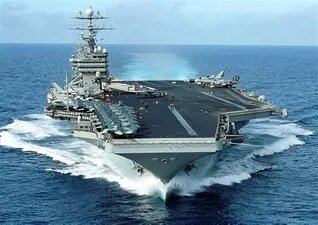
When was the first surprise attack by carrier aircraft on the US naval base at Pearl Harbor, Hawaii? The obvious answer is the Japanese carrier attack of December 7th, 1941. But what about the two earlier attacks, February 7th, 1932, and again in 1938 . . . . . . . ? Early on the Sunday morning of February 7, 1932, (same scenario as in 1941), the American aircraft Carriers USS Saratoga CV2 and USS Lexington CV3 launched a surprise attack on Pearl Harbor. Instead of high explosive bombs, they dropped sacks of flower and scored direct hits on the airfields and all the ships in the harbor.
The surprise attack was part of “Grand Joint Exercise No. 4” and was intended to simulate a Japanese attack on the naval base. The mock-attack was designed to test Pearl’s defenses and assess its vulnerability to an attack.The attacking force was under the command of Rear Admiral Harry Yarnell, who was one of the few admirals who was also a naval aviator. Back then, Aircraft carriers were still a relatively new technology, both the USS Saratoga CV3 and USS Lexington CV2 were originally intended to be battle cruisers but were converted to aircraft carriers while still on the building ways.
They were only the second and third carriers in the Navy, and were the first truly “large carriers”, both entered service in 1928, in 1932 aircraft carrier tactics were still being developed. In previous years, mock naval attacks on Pearl Harbor had always featured only battleships and cruisers. Radio traffic from the approaching Carrier fleet would tip off the defenders at Pearl Harbor and allow the in-harbor fleet to take to sea for the mock battle.
In charge of attacking Pearl… Admiral Yarnell had most of his fleet still in San Diego, he held his battleships and cruisers back while at dawn, his carriers approached under radio silence, when in range Yarnell launched 152 planes from the two carriers... the surprise was complete. The observer judges ruled that the mock-attack was a complete success !.
So… did the Navy pay attention and take meaningful action to ensure that no such attack could ever succeed again? Of course not. They basically replied, “You can’t sink my battleships” carriers are not the future. The brass said that Yarnell had cheated. He had attacked at dawn on a Sunday morning, a time considered “inappropriate” for an attack. His attack vector from the north-northeast had mimicked planes arriving from the mainland.
Most importantly, the Navy argued, low-level precision bombing of battleships at anchor was unrealistic, since “everyone knew that Asian peoples lack sufficient hand-eye coordination to ever engage in that kind of precision bombing." Pressured by the War Department, the umpires reversed their decision and declared that the defenders docked in Pearl Harbor had won the exercise. The Navy and its “battleship admirals” ignored Yarnell’s contention that Pearl Harbor was vulnerable to an attack by naval air power.
But, the exercise was widely reported in the press and was even observed by Japanese naval officers at the Japanese consulate on Oahu, In case they missed it the first time, Pearl Harbor was again attacked by American carrier planes from the USS Saratoga again in the winter of 1938 during the annual war games.
Admiral Ernest King launched this aerial attack to make the point that Pearl Harbor was still indeed vulnerable. But, no one, with the exception of the Japanese at the consulate, was paying attention. The US Navy was still ruled by battleships and battleship admiral mentality, between 1932 and 1941, the navy even ordered twelve more battleships, and reluctantly only four aircraft carriers.
When the Japanese did launch a surprise carrier attack on Pearl Harbor on December 7, 1941, all eight battleships were heavily damaged and four were sunk. The Japanese also sank or damaged three cruisers, three destroyers, an anti-aircraft training ship, and one minelayer, the only “good” news was that the US Navy carriers, including the USS Lexington and the USS Saratoga, were at sea and were not damaged in the attack.
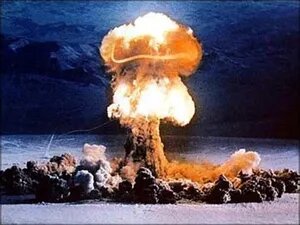
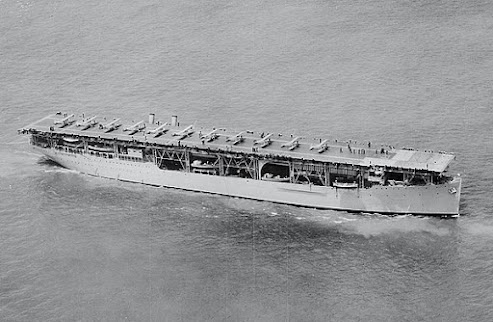
Strangely, both the USS Lexington CV2 and the USS Saratoga CV3 were ultimately sunk by the US Navy not the Japanese. USS Lexington was badly crippled by Japanese attacks in the Battle of the Coral Sea in 1942, on fire and burning out of control, she was sunk by a US destroyer to prevent her from being captured. USS Saratoga survived the war only to be sunk in 1946 in tests of atomic blasts at Bikini Atoll. Their predecessor CV1 Langley, heading to Java, was attacked by nine twin-engine Japanese bombers on 27 February 1942, and so badly damaged that she had to be scuttled by her escorts.
—-------------------------------------------------------------------------------This was the end of the "experimental" carrier prototypes, and the beginning of the
CV-4 Ranger (1934) Class carriers -built as "carriers".—-----------------------------------------------------------------------------